
If you are planning a Thai wedding, the day arrives with a running order most venues expect you to have settled already. Which rituals you keep, what time they begin and what each needs from the room are decisions you make before anything is booked.
Thai wedding traditions follow a clear sequence, and nearly every one of them carries a practical requirement behind it.
This guide walks through the day as it unfolds, flags what you need to decide or arrange at each stage, and sets out what a venue should already be providing.
It starts with the auspicious date
Before anything else is booked, the couple settles on an auspicious date. Families consult a monk or an astrologer, who works from the couple’s birth dates and birth times alongside the lunar calendar.
The result is often an early hour, treated precisely rather than approximately. Three and nine recur in these calculations because both are considered lucky, which is why a procession might be timed to a moment like 09:09.
For anyone planning a traditional Thai wedding, this is the first decision and it constrains the rest. You approach venues with one specific date rather than a choice of weekends, so settle it before enquiring.
The morning begins with merit-making
The day opens with merit-making. Monks chant and bless the couple, and the couple offers alms in return.
Monks attend in odd numbers, commonly three, five, seven or nine. The chanting usually starts early, often around six or seven in the morning.
During this part, the monks bless the water that will be used later for the water pouring, so the first ritual of the day and the central one are directly connected.
What this means for planning: you need the room, and your closest family, from early morning. If the ceremony and reception share a venue, that is a full day of use, not an evening booking.
The Khan Maak procession and the door ceremony
The groom does not simply arrive. He leads a procession, the Khan Maak, from a set meeting point to the bride’s family, with relatives, friends, drummers and dancers alongside him.
The party carries banana and sugarcane plants, flowers, food and gifts for the bride’s family. It is loud by design, because everyone should see the groom come to ask for the bride.
At the destination he meets the door ceremony. The bride’s relatives and friends hold symbolic gates across his path, often a gold or silver chain or a string of flowers, and he negotiates through each one with a token payment. The tolls rise at every gate, and the teasing is part of it.
For planning, the procession needs a route: an approach where the whole party can walk down, with room at the front for drummers and dancers.
Sin Sod, the dowry presentation
Once the groom is through, the Sin Sod is presented. This is the dowry the groom’s family offers to the bride’s family, usually cash, gold or jewellery, laid out for both families to see.
It is counted in front of everyone, traditionally on a red cloth, which makes it a formal moment rather than a private arrangement. Accounts of what shapes the amount point to the groom’s means alongside the bride’s family standing and education.
How much weight it carries now varies. Sin Sod is a custom rather than a legal requirement, the figure is negotiated between the two families, and some ask for none at all. Where it is given, it is often returned to the couple afterwards, in full or in part, though that is not something to assume.
The white thread and the water blessing
With both families joined, the Thai wedding ceremony itself begins. An elder places a Sai Monkhon over the couple, a length of white cotton formed into a circle and laid across both their heads.
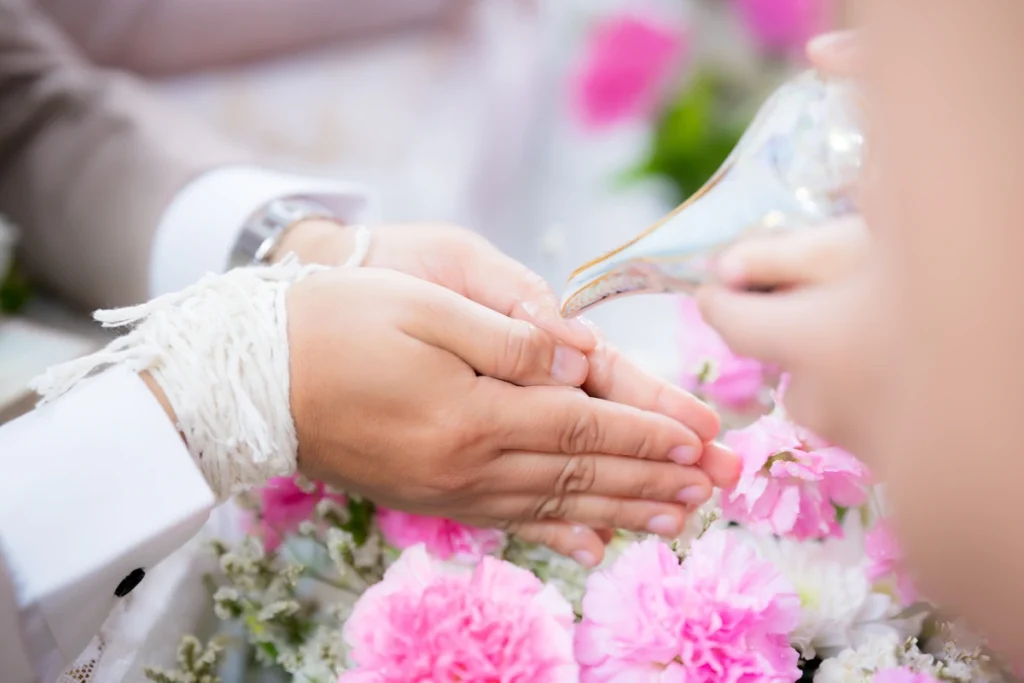
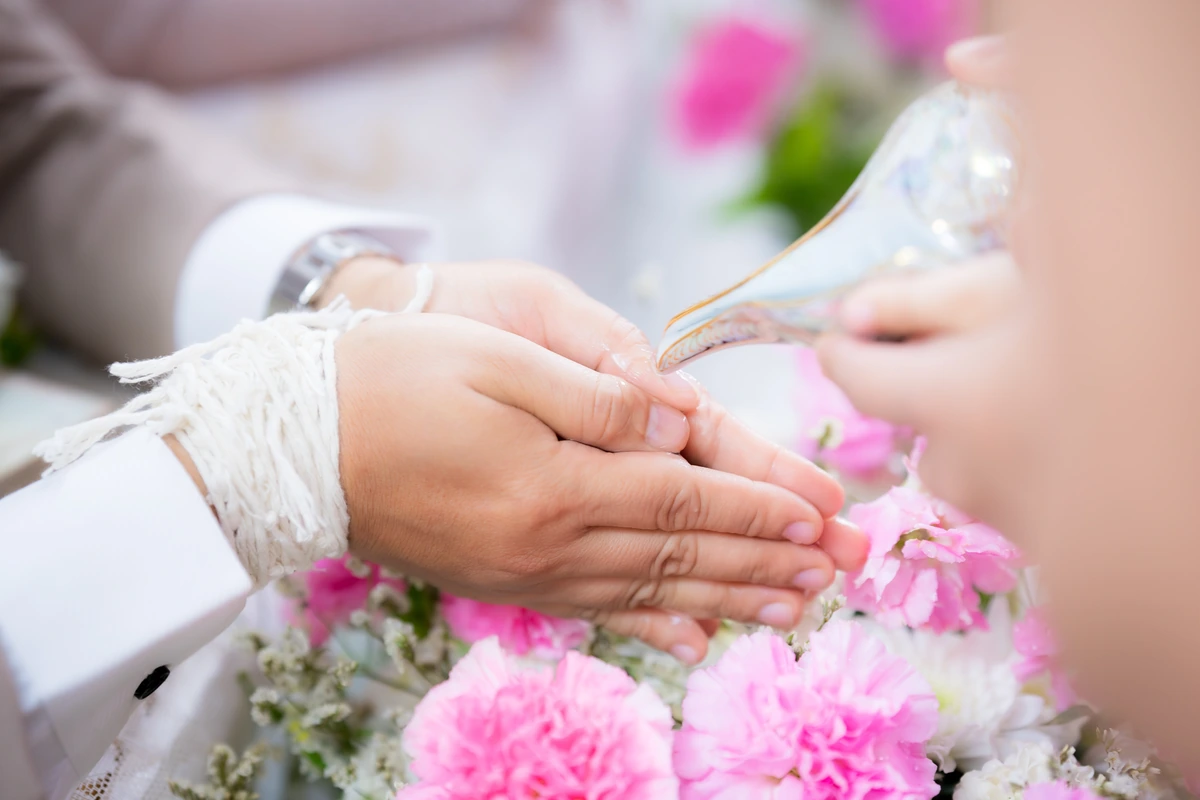
Then comes Rod Nam Sang, the water pouring, which most couples treat as the heart of the day. The couple kneel with their hands held out over a tray of flowers while guests queue to bless them.
Each guest pours blessed water from a conch shell over the couple’s hands and offers a few words, going in order of seniority so the eldest relatives are first. Before the pouring starts, an elder marks the couple’s foreheads with white ceremonial paste.
This is the ritual with the largest spatial demand. Every guest files past one at a time, so the room needs a queue route that does not cut back across the seating.
The bed ceremony and the evening reception
After the blessing, a couple long married prepares the newlyweds’ bed with symbolic items and words of blessing, so the good fortune of a long marriage passes on. The items stay with the couple for three nights.
The evening reception is the part most guests recognise: dinner, speeches, music and photographs.
Wedding traditions in Thailand concentrate the ritual in the morning, so by evening the mood shifts to celebration. If relatives are travelling in from other provinces, booking rooms at the same hotel saves anyone driving home after a day that started before dawn.
What a wedding venue should already provide
A venue that runs weddings regularly supplies more of the ceremony than couples expect, so ask what is included before buying ritual items yourself.
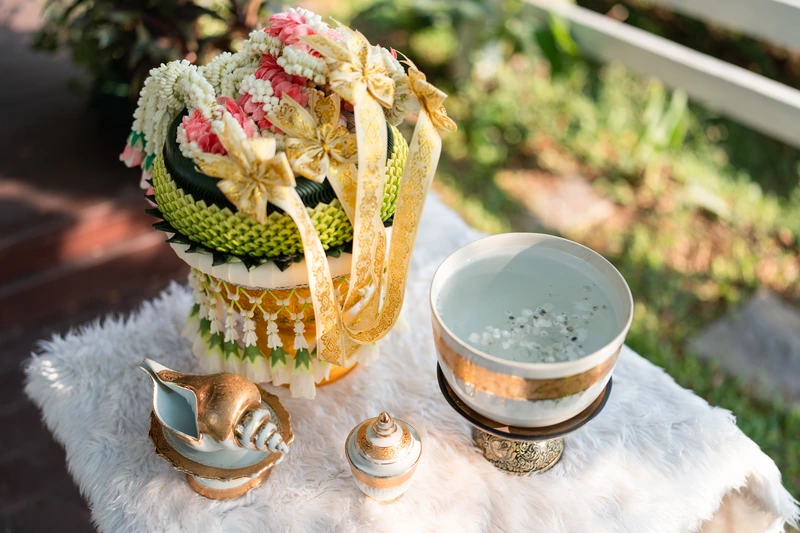
At Town in Town Hotel, which has hosted more than 1,000 weddings since 1993, the Thai ceremony package covers the ritual equipment itself: the altar table and Buddha image, the brass stand and two trays for the blessed water, the conch shell, the forehead paste, and a pair of sai monkhon threads with ceremonial garlands.
The monk ceremony package goes further. The hotel invites nine monks, arranges their transport to and from the venue, and provides their seating on the stage, their meals, the alms offerings, the sacred thread and the holy water bowl.
What stays with your family is the ceremonial host or MC, the khan maak itself, the gifts given back to elders, the items for the send-off and the monks’ offering envelopes. The personal parts remain yours, while the equipment and the logistics sit with the hotel.
The engagement package also includes a place at the hotel for the bride to be collected from, which matters if the procession is on site, and a suite for the couple with breakfast. Receptions run as a cocktail, a Thai buffet, an international buffet or Chinese banquet tables.
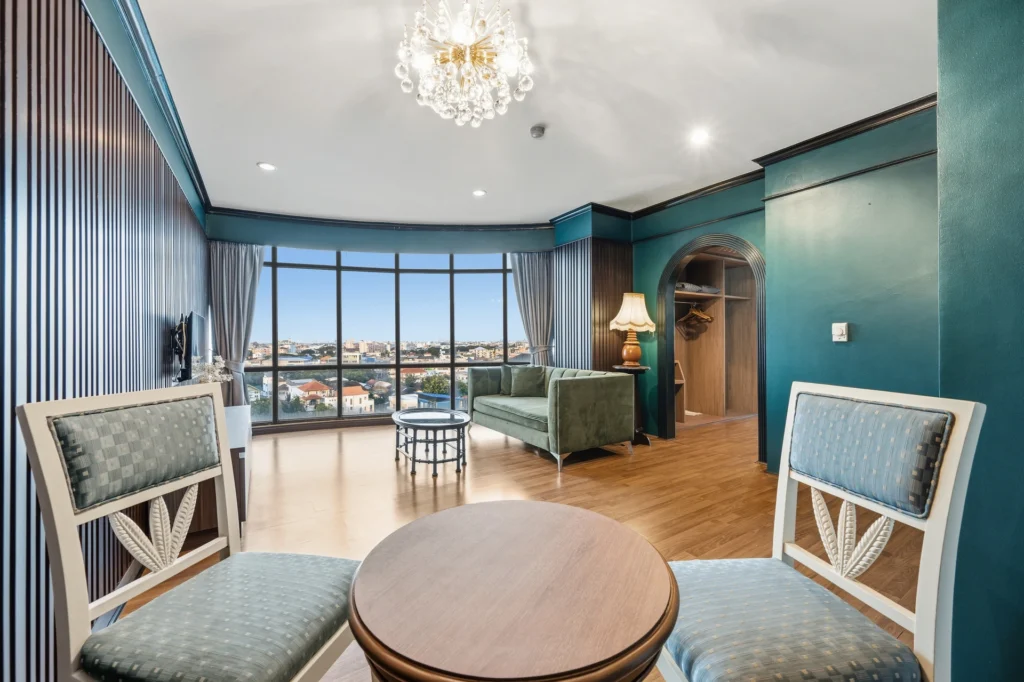
The room’s design follows Feng Shui principles: two central chandeliers encircled by eight more, an earth-yellow wool carpet, and warm wood and fabric panelling, chosen to bring balance into the room from the first ceremony. For couples weighing up a wedding venue in Bangkok, that mix of space, service and intent is worth seeing in person.
Planning a traditional Thai wedding day
Thai wedding traditions reward early decisions. Fix the date, agree the running order with both families, then take that sequence to the venue, not the other way round.
If you are planning a Thai-Chinese wedding, the Chinese side of the day, from the betrothal gifts through to Chinese wedding ceremonies.
If you are planning a wedding in Bangkok and want to talk the day through, message the Town in Town Hotel team or send an enquiry through the contact page. The team runs engagement, Thai and monk ceremonies in the same space, and is happy to advise before you commit to anything.
View PackagesFrequently Asked Questions
How long does a traditional Thai wedding day take?
A traditional Thai wedding runs from early morning through to the evening rather than filling an afternoon. The monks’ part of the morning commonly begins around six or seven, timed to an auspicious hour, and the procession, the dowry presentation and the water blessing follow through the rest of the morning. The reception then takes the evening. Couples planning the day should assume they need the venue and their closest family from dawn rather than from midday, which is one reason many families keep the ceremony and the reception in the same building instead of moving guests between two places.
Which Thai wedding rituals can a couple leave out?
There is no fixed list, and families differ widely in how many rituals they keep. Regional custom plays a part too, with practices varying between the north and the south of Thailand. The water blessing, Rod Nam Sang, is the element most accounts treat as essential, since it is the moment the couple is recognised as married by everyone present. Beyond that, couples usually build the day around the rituals their families care most about. The practical approach is to agree the running order with both sets of parents first, then take that fixed sequence to the venue.
What does a couple need to tell the venue when booking a Thai ceremony?
Give the venue the confirmed date and start time first, because a Thai ceremony is timed to an auspicious hour rather than a convenient one. Then tell them which rituals you are keeping, since each carries a different spatial requirement: seating for the monks, a walkable approach for the procession, and a clear queue route for the water blessing. Ask what the venue already supplies too. Town in Town Hotel provides the water-pouring stand, conch shell and sai monkhon threads in its Thai ceremony package, and invites and transports the monks in its monk package, so the running order can be agreed with the wedding team ahead of the date.
Does the wedding venue supply the ceremony equipment, or do we bring our own?
It varies by venue, so ask early, because the ritual items add up. At Town in Town Hotel the Thai ceremony package covers the altar table and Buddha image, the brass stand and trays for the blessed water, the conch shell, the forehead paste and a pair of sai monkhon threads with ceremonial garlands. The monk ceremony package adds the monks themselves, nine of them, along with their transport, seating, meals and alms offerings. What families still bring is the ceremonial host, the khan maak, the gifts returned to elders and the monks’ offering envelopes.
What happens during the Thai wedding water pouring ceremony?
Rod Nam Sang is the blessing that most Thai couples treat as the heart of the wedding. The couple kneel side by side and hold their hands out together over a tray of flowers. Guests then step up one at a time and pour blessed water from a conch shell over the couple’s hands, letting it run from the base of the thumb to the fingertips, offering a few words as they do. Guests go in order of seniority, so the eldest relatives bless the couple first. Before the pouring begins, an elder marks each of their foreheads with white ceremonial paste.
What do guests wear to a Thai wedding?
Guests should dress smartly and avoid black, which is considered unlucky at a Thai wedding. Leave out t-shirts, vests, shorts and flip-flops. For the morning Buddhist ceremony, modest dress is expected, so bare shoulders, spaghetti straps and short skirts are best avoided. Loose, lightweight clothing is the practical choice, because the ceremonies run long and the rooms get warm. Thai silk, a smart shirt or a formal dress all work. If you are unsure how traditional the day will be, ask the person who invited you, since families differ in how closely they keep to custom.